Eclectic Tech Carnival Herstory/Ourstory
In Conversation with Donna, Aileen, Anne and Helen [6. August 2024]

nate: We’re gathered here at the eclectic tech carnival (/etc) in 2024 in Berlin Kreuzberg in a community center and feminist hacklab, the Heart of Code at Bethanien. Some participants proposed a session about the 'Herstory and Ourstory' of /etc. From that came the idea to document a little bit of that. And we do that while we eat. [laughter] I brought some questions but I think we will just be in conversation. First I want you to tell about your initial involvement with the /etc or the Gender Changers Academy. What was your point of access but also, what was your relationship with computer technology at that time?
Donna: My name is Donna and I could call myself one of the founders of the /etc.
I am not one of the founders of the Gender Changer Academy but I was one of the first participants and I have kept it going. At the time I was working and living in Amsterdam. This was 1999/2000. I was working as a nurse. I had quite a lot of experience as an activist before that already. I knew a lot of people in the squatting scene, in the environmental scene, the women’s scene, the gay scene. Anyways, I had gone to a bookshop. And in the cellar of the bookshop was an internet cafe called the ASCII. And that really blew my mind. Because it was free. At the time if you wanted to go on the internet you had to pay money. You had to go into an internet café – there were a couple of them in Amsterdam – and it cost lots of money. It wasn’t easy and it wasn’t cheap. And here there was a group of people that had rebuilt computers from hardware they had found on the streets and gotten from academia, places they were studying or wherever. And they had put free, open source software on the computers. They sold beer and with the money they got from the beer they paid the cable accounts. It was a dial-up internet connection. And I just thought that the whole scene was really brilliant, I really loved it. I also liked the aesthetics of the cellar. I always liked the DIY aspect of it, I liked punk and squat scene aesthetic. So that attracted me. But in this café I struggled to get a bond with the guys. There was also a couple of women hanging around. And I got chatting with the women and I was saying how I was struggling to understand, struggling to get the guys to teach me stuff. And they said that they had exactly the same experience. They decided, why don’t we, you know, start a little group of our own, a women’s group and they called themselves the Genderchangers. They met once a week in the ASCII.
The space was kind of dirty. There were dogs and smoking, and the toilets were always dirty. And we decided that on the night that was gonna be women only night we would clean the toilets. There would be no distraction, there would be flowers, there would be tea instead of beer – the usual things that make us more comfortable and that we enjoy. I followed their second Hardware Crash Course and helped develop it further and write the manual.1 That is how we started the Gender Changer Academy. And I have to say that what is interesting and the thing that I always explain about this group and why I stuck with them is that we all had backgrounds in either feminist or some kind of activism like environment activism. So that was one thing that connected us and the other thing is that we became friends through the projects. That also really helps when you’re thinking about longterm prospects. You know, for us it wasn't because we wanted to get famous, we wanted to make money or whatever. For us it was really to help us out, together in solidarity. And at the same time we were having fun and we became friends. And you know, I think that is really important.
nate: I already got two questions to give the others more time to eat. You said what drew you in were the aesthetics. But at the same time when you made it a women’s place you changed the aesthetics a little?
Donna: Look, I still like the punk aesthetics, it just needs to be cleaner. [laughter] Yeah, see, I don´t know whether in punk dirt is an ideology. I think actually, at the end of the day, we just don’t have enough time or interest. Or we think other people should clean after us which is a big issue in the leftist scene. If we cannot clean our own toilets, then we are doomed really. If we always think someone else has to clean our toilets then we’ll never be liberated, emancipated. But of course the guys will say that the reason the toilet is always clunked is that the women are throwing the tampons in.
nate: And the other question is, that, ok this was a possibility to go on the internet for free. But what drew you to the internet back then?
Donna: Yeah, that is a very important point for me and why I have always been so positive about technology. I am a migrant. When I first moved to the Netherlands I was incredibly lonely. And this was the only way for me to connect with my friends. I used to write postcards and letters and stuff and sometimes I would't get a reply or it would take forever to get a reply. And when I started studying at the Uni in Rotterdam which was a college for nursing, I studied nursing, they gave us an email account. For me that was... honestly, I would come into school really early as soon as the school was opened so I could check my mail and I would stay late so I could check my mail. In the morning I would send my friends an email and in the evening I would have a reply. So I can really imagine how technology has helped migrants in so many ways or people that move around for whatever reason. And then later on I was one of the first users of Skype but since Microsoft bought Skype, I wanted something else. So internet really was a personal... how do you say that? It was personally very important. When I saw this hackspace and I was thinking about the internet and computing I realized straight away that this would influence our culture in a massive way. And I was not sure if I realized that because of my personal addiction to it or how important it was for me. I think I also knew politically that it was gonna have consequences.
nate: Thank you.
Donna: I just wanted to say, sorry one more thing! When I realized that the internet and computers were gonna have such a big influence on our culture I decided I’d rather be in it and understand it than to be dependent on it. So I decided to switch from nursing to IT so I could be flooded by it and I could figure it out for myself.
nate: Who is next? Same questions!
Aileen: I am Aileen. I was just thinking, listening to you Donna, about what was interesting at the beginning. For me it also had a lot to do with activism and feminism. I was working on Aktionskommittee: Asyl für verfolgte Frauen und Mädchen, a project that was trying to put pressure on our government in Austria and other governments to recognize rape as a ground for political asylum. This was in the early 90s in the midst of the Balkan war and there were incredibly horrible reports coming out of Bosnia at the time. I was collecting media reports and things that people were sending us, trying to coordinate different groups and put together a reader. And I started getting short articles in this very strange format. And a colleague who had just came back from a Fullbright scholarship in Canada recognized it and said 'Oh, that's email!' She showed it to me. So the first emails I ever read in the midst of this political campaign were desperate pleas for help from women's shelters in Belgrade that were overflowing, which was news that we would otherwise not have had at all. And that's why for me, suddenly I realized this is really, really important. To hear from people directly about what they need and not from politicians or whatever.
I had been interested in computers before. So, after Peter and I were married he became curious and started learning about computers, too. Then in 1994, I started my business as a translator and I was very soon asked to help translate a revision of one of the first books on Linux. It was 80 pages at the time [laughing], "Unleashing the power in your PC" or something like that. I was asked because I was one of the few translators who already had an email address and understood email. And I hadn't heard of Linux but I knew at least what an operating system was and why it was important. There was a short paragraph saying there is this new thing called Word Wide Web. And we don´t know where that is going to go yet, but it is interesting so keep an eye on it! [laughter]
So Peter and I, because I had gotten Peter interested in computers, we bought our first computer just after we were married, and then we had room so we had a second computer. And as I was translating this book, Peter set to trying it out. We were experimenting, trying to connect different computers together, the first three. We called our little network Eliot. The first server was called George, after one of my favourite authors, George Eliot (that was her pen name, her real name was Mary Anne Evans). The second was a dual-boot machine with Linux and Microsoft called TS after the British-American poet T.S. Eliot. And the third was a Windows machine for the boys for playing games, and we called that one E.T. In the film E.T, Elliot is the name of the little boy. All that is left of that network is my email address, which is why I have this strange email address [laughs] that I am holding onto. So, Peter and I were experimenting with trying to connect computers. And when I saw this email, I came home and I said: We have to have this. We need email. We have to set up email on our machine. So this went on for some time. And our sons got interested and I had the feeling with my three men and then the boys' friends from school, the room was always full of, yeah, full of these guys. And eventually I said, okay, I want my own laptop, that will be only my laptop and nobody else gets to touch it. And Peter was very reluctant, but he finally gave in and gave me a laptop for Christmas. And I first shared that somewhere on a mailinglist or something, and Nat Muller from Rotterdam replied to that 'yes, every girl needs her own laptop.'
And then she started telling me about this group in Amsterdam, a group of women. Something about a woman with a screwdriver. These women in Amsterdam were doing something really interesting. And then Peter and I were invited to Brussels and that is where I met Donna. And that was exactly the group I really, really wanted to be part of. So when the announcement of the first /etc in Pula came, it was, I don’t know, September or something, again one of the times when I was working for Ars Electronica and waiting desperately for them to pay me in time to go shopping with my sons to buy school supplies before my kids were in trouble for not having their notebooks yet. And I couldn’t go and, oh, I was so jealous, and so I was following all the news. It took a while, then there was Athens, there was Belgrade, and it was so frustrating that I couldn't get there until finally it was in Graz! And so of course I got on a train and I went straight to Graz.
Anne: I can go on. I am Anne, I am from Berlin. However, I don´t remember how I got involved. [laughs] I can retrace some memories and I have about a guess but I don´t remember the exact time. I don’t remember when we first met to be honest. I think at the same time, as you two said, around the turn of the century, in 2000/2001 I was involved with the media activist group Indymedia, which was an international network of media activism and it was extremely male dominated. There were some women but not very many. Through this network, which worked very internationally, I got to know some of the Dutch techies that were also involved in the ASCII hackspace in Amsterdam. And it must have been through this somehow that I heard of the Gender Changers and /etc. What was sort of eye opening to me was the experience within this media activist network which was like... I loved these people, it was great, one of the greatest activism things we did at the time! But I came from an activist background, not tech activism, so I knew very little about computers. My perspective was media activism, journalism, reporting, not so much understanding the details of technology. But since technology wasn’t so evolved we had to do a lot of stuff ourselves. And even though the people involved were really helpful and it was easy to learn things and ask questions I still kept hitting this wall of, 'well, if you want to do this you have to set up your own mail server, administrate your own server... it's easy, you know' and I just sort of had to learn how to encrypt emails which we did because we didn’t want our emails to be read, you needed to do PGP on a console.. I don’t know how it is called anymore -- with a terminal command which... I mean I did all that and I could handle it but still I thought my need in this is not how to learn to get to the bottom of all these technical things. That was not actually what I came there for. Like, whenever I said 'I don´t get it and can someone sort of find a way so that it is easier to handle these things so we actually get the reporting done', I kept hearing 'Yeah but you just need to learn dadadadada. It's easy.' [laughter] Whereas with the Gender Changers I had the feeling the whole atmosphere was extremely different! It was not so much giving you the impression that you just don’t know enough, and you just didn't try hard enough, that 'is easy, just do it'. It was more “we are all learning, we all don't really know how these things work, we teach each other and it's okay not to know things”. It’s okay not to aspire to have a 150 percent of deep tech knowledge. And that was so relieving to me. In this network, it was always very different. Since then I have one foot in both communities and it stayed that way in that the approach was always very different. Here the focus was always on being open to each other in helping and accepting that we don’t know all the things.
The first /etc that I actually went to in person, I think, was the one in Linz in 2007. I am not sure about Graz but I don’t think I was there. Don’t really remember. I followed it always through mailing lists. And there was the attempt to do a bit of streaming for those who couldn’t come to participate as well. I had two young children at the time and to organize child care for little kids was just not an option for /etcs at the time. Also I had very little money and so many times I couldn’t go. And when I finally got to the first one in 2007 it was so great.
nate: I also have a follow up question for you: For this kind of media journalism at the time how was the technical setup and how were computers involved?
Anne: How many hours do I have? [laughter]
nate (jokingly): One minute!
Anne: No, seriously, can you be a bit more specific?
nate: I don’t know, I really just don’t know what media journalism looked like in the late 90s.
Anne: That is going to be a long answer... We didn’t have anything. Basically the way Indymedia started through several things happening at the same time. One is that a hacker group in Australia invented the first ever content management system, the first ever website where you could just type text into a form rather than understand HTML and CSS and server administration. That was turning the tide totally in that all of a sudden, people could just publish something on the internet. And the other was the anti-globalization protests at the time. When that came together, Indymedia started to bloom. So it was content management systems run on servers. Indymedia had a very strong ideology about being open source always, free/libre software (FLOSS) that was administrated by ourselves in a participatory way and in an international way. So there were working groups that communicated through IRC mostly and mailing lists. Nobody was paid and it was all volunteers, that was how the administration was done. And on these servers were websites by local and national groups. In the beginning it was easy to publish text. It was not so easy to publish pictures. And I am not sure, is that were your question was going?
nate: Yeah!
Anne: So that is how we started.
Aileen: As a reader of Indymedia at that time, one thing I really appreciated was that I didn´t have to log into a desktop, I could read it with Lynx, a text only browser. So I could read my emails and Indymedia just in the terminal, which I always appreciated very much.
Anne: In the international Indymedia network we had local groups, but there were also working groups on specific issues. There was a tech working group, a language working group and at some point we also started a women’s working group. This is how I met Gaba, who unfortunately cannot be with us but who was meant to be here today. So we pushed for more gender equality within the network and representation. At some point Indymedia developed a set of criteria defining requirements to become a member (group) of the network . Because you see, we couldn´t interview people in person since it was a global network and we were not in one place. These criteria defined some basics for new groups, e.g. they needed to make sure that different political backgrounds were represented, that the local groups were open to anyone who wanted to participate. And then
as Indymedia women, we said that member groups needed to have a gender balance as well, and so that became part of those membership criteria.
nate: Same questions for you!
Helen: I am Helen. Well, it’s interesting because when everybody else was talking, I started remembering other things and thinking 'oh yes, oh yes, oh yes.' I don´t know how much you want. I first became aware of email around the end of the 80s, beginning of the 90s, through university and through the libraries. Because I had worked in the libraries and also in student politics. I came to student politics through the women's rights collective, so I was already involved in feminist things. It must have been about 1989. The student radio station had email and it was how they were getting the news, and the conflict in East Timor was just exploding. I can remember that they were getting emails from East Timor that was instant information about what was happening there. That was the first time that I was aware that we could get this immediate news, through this thing called email. And in 1991, I was the student president and I was the first president to have a computer in my office. So all the presidents before there had been computers, the secretary had typed up their letters, all that kind of thing. They were not all men but I was the third woman president in 150 years of this university. But yeah, I was the first one that had a computer in the president’s office. And then of course from then on they wouldn't even imagine not having a computer there.
Is it the next workshop? Ok.
Donna: So we carry on somewhere else?
Helen: We move? Ok.
[We move to an outside spot.]
Helen: My first email address that I had was in 1994, when I worked for a community arts project, it was helen@artslink.co.nz. Artslink was a database of arts information that we were gathering locally. And at a certain point we thought, 'This needs to be on the internet'. And we also had been doing workshops for artists about the beginning of the internet at that time. We tried to get money from the Arts Council saying we want to make this an accessible database of arts information for the community. The university was going to help us do it and we needed 20.000 dollars. The Arts Council couldn’t understand how people were going to access it, and we said, well, they can go to the library, they can go to internet cafés, and soon people will have internet in their homes. And the Arts Council couldn’t... they were just not there. So we didn’t get any money and the whole project just disappeared. And then about 10 years later another group had the same idea and now it is this huge hub of New Zealand arts information. We were just 10 years too soon! [laughs]
But then I worked in the internet industry and came into discovering people, that were doing... because my passion and my background is theater. So then I discovered people who were making live performance on the internet and I started working with them at the end of the 90s. At this time I'd also begun travelling and connecting with networks like – I can’t remember when I got on Faces, it might have been early 2000s. But at some point around the turn of the century I was on a number of different email lists, like Faces and Furtherfield and Netbehaviour. And an email came through about this Eclectic Tech Carnival in Pula. And this was like, you know, the sort of email that I had been dreaming of without knowing I was dreaming about it. At that time we were using a whole lot of different free software to make performances on the internet, like whatever chat applications or video conferencing software we could find. They were all proprietary. We were basically hacking them, except we didn´t think of it in that respect. We were using either software for business or social chatting software. We were using it for creating performances. And it was always that we came up against these frustrating limitations of the software, that we couldn’t do what we wanted to do. So I was starting to think, yeah, we should try make our own software.
But not being a programmmer apart from coding HTML, this was completely, you know, a fantasy. [laughs] Pula was 2002 and at the end of 2002 we got the funding to build UpStage. So it was coming at the same time that I was having this awakening of the idea that maybe we actually could build our own platform, which was quite exciting. And so then the idea that there were women who could do this also was pretty exciting. But I couldn’t go to Pula. I don’t even really remember much, I must have read about Athens, I suppose. It was a mailinglist quite early on and I must have come on to that as soon as I saw the thing about Pula.
Donna: It would have been the Gender Changers mailinglist to start off with. That was the initial mailing list. It was quite active. There was quite a lot on it for quite a few years
Helen: So then I managed to go in 2004, in Belgrade. At that point we had just launched UpStage and we used UpStage to sort of stream it. We only had motion JPEG streaming because that was all that was really possible with what we were doing. So we had a webcam set up somewhere and it was pushing out lots of images and maybe Aileen was looking at it.
Aileen: I think so. Aha.
Helen: My journey with UpStage had been kind of parallel to my journey with the /etc. And Gloria, who is our lead developer now, came in 2007. I don’t know when she got involved in the /etc but...
Donna: I think Amsterdam. No, I think she was in Linz, you are right.
Helen: Linz was 2007. And I wasn’t at the /etc in Linz but I did a remote presentation or workshop, I can´t remember, in UpStage. And Gloria paid attention and followed it at the distance. And in 2020 she became our lead developer.
nate: Short follow up question because I cannot quite imagine: How does a live performance with the internet or streamed through the internet did look like?
Helen: It is not about streaming. Well, we use streaming but it is not like putting a camera in front of a performance and broadcasting it. It is about the internet being the place where the performance is happening. Anything that you do on the internet, so you can chat, you can have images and animation, texts and computerized voices and you can have audio visual streams as well, you can draw, you can have all kinds of things. So the idea with UpStage is that we can use any of these media in a collaborative platform that allows artists who can be wherever they are to be collaborating in real time for audiences wherever they are. And also the interactivity – the audience can be chatting, they can be responding. Now we have more features, they can use their webcams and microphones if we want them to. So it’s really about collaboration and interaction using all the different kinds of media possibilities. Some performances are much more audiovisual streams, and many performances don’t use audiovisual streams at all.
nate: And would you say that it is part of the netart bubble or is it something different?
Helen: Yeah, well, it is part of it but it is also diverging slightly. What is interesting to me because I come from theater, and theater people were actually for a long time nervous or distant from the technology side. You know, we are about the body, we are going to make funny noises with our voices and do weird shit with our bodies. We don’t do machines, we do bodies. And then the people that are doing the machines don’t really understand theater. So I am often presenting my work, either at a theater conference or a geek thing. And often I am the weird one wherever I am. So the other thing with the /etc is, it has this crossover of arts and activism as well as technology. And a lot of geeks who are into things like gaming or the more creative side of technology. That is a really good place. Yesterday, at my workshop, people were really excited and enthusiastic. Whereas two weeks ago I was teaching at the Arts Academy in Munich, and the students were a little bit unimpressed, not sexy enough for them, that kind of thing...
So I think the /etc is a really important space that we have created. Yeah.
nate: As participants and also as observers of the /etc over the years, have you noticed a shift in what skills are being shared? Because of course the technological regime and the way that technology marks our lives has changed drastically from 2002-2024. Did you see this shift reflected in the skills that are needed and shared, that people bring or develop?
Donna: Yeah, what was interesting this time was the Cubes workshop, which was promoted like a tech workshop. In the beginning of the /etc we had 'how to install Linux on your laptop' kind of workshops that happened for a few years. And now we are gonna learn how to install Cubes, which is actually about identity management.
And that is very modern, I can't remember... well, that is not true. I do remember in the beginning there was a cyberfeminist at a hackers camp that I was attending and she asked us if we were cyberfeminists. I said no, I have no wish to use an alternative name to hide my identity, pretend I am someone else, a man for example. On the other hand we were using nicks on IRC, we were thinking about identity management in the beginning. That seems to be a strong focus at the moment: How to use technology in a good way, to protect yourself, to be anonymous. Another thing is, yesterday there was a high level tech workshop and there were hardly any people in it. And that is also interesting to see in the /etc. The really high tech workshops that do not attract so many people. But there is always one or two, and it's still happening and that’s great. Also in Bologna there was a fantastic... what was it again, some really hard React programming thing. [laughter]
But it still happens, so it's very good. In the beginning I was telling friends about this kind of stuff and they didn't understand it at all, I would say: 'Don´t be scared if you don't understand it. You have been to the opera and you don´t understand opera. You still go to these events to let it flood over you, it is what you take with from it.'
Helen: I just keep doing the UpStage one, and UpStage is evolving and different people come at different times and I am still doing it 20 years later. And you are still doing the hardware course (talking to Donna). And I was getting a kick out of taking the screwdriver, even if I never get much further. I think it is just fun and it gives me this feeling of empowerment and it gives me confidence also, when I do things, replace a hard drive, I know that I can actually do this. So I think there are certain things that will never go out of fashion.
Anne: I remember, that must have been either Linz or Amsterdam, I remember thinking I have nothing to share, I don´t really know anything that anybody else doesn’t. And then someone said 'you know how to administrate mailinglists'. And actually I did. So I did a workshop on the administration of mailing lists and that was very much appreciated. I am not doing that anymore because mailing lists aren’t used much anymore. Back then it was easier to understand how things work. Now the means of communications that we use, I just won’t get to the bottom of it. It is mostly commercial and there are some non-commercial ones, but even Signal messenger is something where we don’t have an administrative level that we can actually manage. So there is nothing to teach. Technology has just evolved a lot in a way so that we can learn how to use it but not much more.
Aileen: I always had the same feeling that Anne just described. I don’t know anything that anybody else doesn’t know already.
nate: Real understatement! This was actually also addressed in your workshop on 'How to explain how the internet works'. There is a certain kind of tech knowledge that seems more natural to older generations – to really in a way understand the device, a device that still has an on- and off button and some kind of simplicity because you had to tamper with it in order to get it working. That knowledge is no longer amongst us.
Donna: At the /etc in Belgrade there were workshops on HTML and CSS and these kind of things, and now people that are in web design, they don’t know that. But I think that if I want to drive a car, I should know a little bit about how it works, that I need to put petrol here, oil here and how to change a tire. Now, you don’t need to know anything and it is all obscure. Sometimes I think, maybe we should go back and do an HTML workshop, because there are a lot of things that we are thinking differently about – why we are doing them and how – when we have that actually very simple technical understanding. And also just the path that information goes. It was touched upon in a new workshop and maybe in... you know like all the things about IP and HTTP and all of these kind of things, the way the tech industry has gone. You don’t need to understand it, just use the really simple app and don't worry about stuff. And we are all really encouraged to just accept that – and now with things like AI, actually that is how they get away with it. Because we are being kind of told to just trust them, and it is really obvious that we shouldn’t.
Anne: Which makes me think of something ironic. The four of us, we are like the stereotype of people who don’t know anything about tech. These older women who know nothing are always the example of 'these people also need to understand how to use Facebook'. [big laughter]
I am always confronted with this sterotype of digital natives, the youngsters who understand it versus us, the people who, no way, 'you're a mom.' And I know a lot of things the digital natives actually don‘t know. Until today I am explaining the internet to my kids, because all the technology has become so complicated. It's nothing that comes naturally. You don‘t understand how it works until somebody tells you. And of course we have a lot of knowledge that seems natural to us but not at all to people who have just been there for 5 years. I don’t know exactly where I am going with this. But I keep thinking about what it is that obscures our relation to technology in a way that comes together in this image that is painted of the older people who 'don’t want to', who 'don't know' and 'can’t handle it' and the younger people who just grow naturally into technology. That is a completely wrong picture that keeps being reinvented with each generation while actually the knowledge about technology is being obscured more and more.
Helen: And it is disempowering! The kids are supposedly the digital natives and they can handle technology really well. Ok, they can handle it. But they don’t question it. Because they don´t even have the technical understanding to ask these questions.
Anne: They are not being taught at school but it is also harder for them, to try to understand that. It takes years to get to the bottom of things. [lots of agreement]
Aileen: A new pet shop opened up close to where my son lives. I go there once a week and they have an app. And the young women working there ask 'Do you have our app? You could save money!' And I would say: 'No, I don’t want the app'. And their immediate reaction was: grey haired old woman is afraid of technology, we have to explain very kindly and gently that it is okay to install the app. I don’t react very well to that. [laughter] So I ended up explaining to them the problem with apps and trackers and how much information is being tracked and sold and all of these problems. They were so nice. And then they started asking me, they recognize me in the meantime. I am the women who does not like apps because of trackers and privacy concerns. 'Oh yes', they ask: 'How did that work?'
Donna: Yeah, I also have experiences. I put off using maps for a very long time, because I didn´t want to use Google maps. In the meantime I found Organic maps and it is so easy and just as good. But sometimes, you know, I like to just wonder around and ask people. 'Am I close to whatever address?' And then they say: 'You can find that on Google maps'. I do know that but I am choosing not to use the app. We know we can do anything with apps and technologies. I think we should at some point learn to say no, slow down and put it away.
Helen: Because often you see people standing on a street corner looking confused. We did that actually the other night. Fuck, my location thing is showing that we are still at the dinner. And we spent quite some time to use our phones. And then eventually I asked somebody and got the direction that we needed. But I have seen it so many times, people that clearly need assistance. And then a couple of times I ask 'Can I help you?' But there is a siloing of people. We are not allowed to ask somebody now, because we should be able to find stuff on the phone. So we are not talking to people. I had really interesting conversations years ago just chatting to somebody that I would never have because they were asking for directions. And now you have to get the app, some virtual tour guide. And there is someone making decisions about what you're getting and how you're getting it.
Anne: I am on the other side of this. I like using these apps, I think it is cool. I got more people who tell me, 'You are online too much'. And I tell them: 'No, I am good. I like these things.' And I find it interesting to think about how it changes our lives and I think there needs to be more thinking about it. For me it is not 'this is bad' but 'this is different'. How is it different to what we were used to? That seems like such a boring question but I find it quite interesting. Because there are so many changes in this society with all this digital stuff and too little thought about how it affects whom. And what about people who maybe don’t have access to it so much and what it means to them.
nate: OK, to wrap up this converstation, one last question, can be very quick. Where do you see potential for young people entering this space that don’t have the nineties experience of 'I need free email', like is there a specific thing for motivating them?
Anne: Empowering oneself, like learning whatever it is.
nate: But people empower themselves with ChatGPT, they say.
Anne: I mean we can discuss about Chat GPT. But I think a workshop on how to write the prompts would be interesting.
Helen: Being independent and autonomous, financially especially. Not being dependent on other people or other instuitutions to be able to live, pay the rent, travel whatever. At the end of the day, I am sure people are gonna see how much money they are giving away to these big tech companies, how they are the product and how poor they are compared to the people making money off them.
Aileen: Also, I think we are seeing the walled gardens are falling apart. People are getting dissatisfied and realizing this is not working and looking around for alternatives. Alternatives like this have always been there and will continue. And I think with the generations, to learn from one another, to see different perspectives from people who never had the chance to learn anything else. Learn how things work and to share these experiences. I think there is interest in that.
Anne: I think the learning about alternatives, as open source and FLOSS software and just show that it exists and to teach it, because some people don't know it very well. And also about secure software and IT security issues which is also something that people don’t naturally learn. I think these are two topics where the /etc could be a good place to learn.
Donna: And I think violence against women is only gonna increase with AI, being able to deep fake the image of a woman. So I think there is gonna be a reaction to the status quo at some point.
Helen: I agree with all of these things and also it's a model of an alternative space, and so I think it is attractive to people who don’t fit well into traditional learning or work structures or traditional structures of any kind. And that it offers a really important model. But I think there could be more /etcs in different places because their beauty is the intergenerational conversation we are having right now and the different spaces and the cooking arrangements and the idea that people can come around and propose something. It is so different to academic conferences or corporate events and normal state education. And I think there are a lot of people that flourish here, that can’t flourish in other places. So I think that is really important as a model.
nate: Thank you so much of this conversation: A little longer than we aimed for but still ok I hope.
What we have to have now is an understanding of what is to happen with this recording.
Helen: Thank you for being interested in the stories. And yeah, what are you gonna do with it?
nate: What are we gonna do? I can make some suggestions in that I can do a transcript.
Aileen: That is a huge job...
Donna: I wouldn´t feed it to the AI.
Helen: Do it the old fashioned way, I know it takes longer, but it is kind of fun. Or is there an open source one?
nate: Okay, I will look how I do it and then we can publish it on the /etc website?
Aileen: Yeah, yeah.
Helen: That is fine.
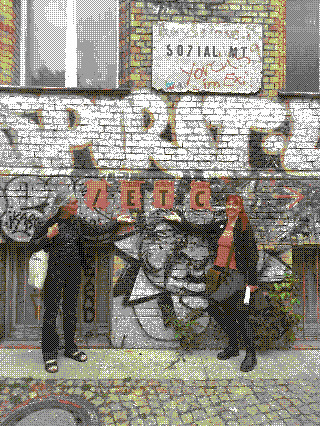
This is a shortened version of our conversation. What is left out amongst others is the part where we discussed identity politics, the forking of the /etc and the THF (Trans Hack Feminist convergence), the shift away from a 'women only' policy and the inclusion of gender queers and trans people. As the interviewing person, I felt that a published text cannot hold space for the ways in which these conversations need to be ongoing. Instead I want to commit myself to exploring ways of 'staying with the trouble' that do not reinscribe or further the pain, hurt and fears as well as the lack of care, misunderstanding and miscommunication which can challenge intersectional, feminist and queer forms of organizing.
Another person who remembers the herstories/ourstories of the /etc is Gaba. I met Gaba during the Global Gathering in September of 2024 and recorded a conversation based on similar questions which is yet to be transcribed and uploaded.